

Summer '36 Review

Director: Frédéric Garson
Date Created: 2026-07-01 19:15
3
Summer ’36 Review: Directed by Frédéric Garson, Netflix’s French period drama L’Été 36 features Julie de Bona in the character of Blanche Acquerman, Sofia Essaïdi in the role of Eugénie Berthier, Constance Gay as Léonie Morel, Miou-Miou as Marthe Pontavice-Caron, Nolwenn Leroy as Giulia Vincent, François-Xavier Demaison as Raven, Sam Karmann as Henri Pontavice-Caron and others. The series consists of six episodes, each of which lasts 55 minutes, and it tells a mystery story during France’s first paid holiday for workers in 1936.
Summer ’36 Review
Netflix’s Summer ’36 begins with families visiting the beach on their highly anticipated vacation, but it soon turns out to be a mystery of murders when the prosecution Adrien Jacquart is killed in his hotel room. All the major characters in this mystery turn out to be the ones who are suspects or are hiding some information about themselves. It is good that the murderer did not remain alone, but each clue gave away some secret of the family.
What works best about Netflix series Summer ’36, without a doubt, is its quartet of women lead characters. All of them have totally different weights when they start out in the drama, but the show manages to find very believable reasons to bring them all together. What I really loved about them was that they were not all perfect heroines. In fact, Eugenie tries hard throughout the series to try and mend her mistakes from long ago, and gets completely shocked after Jacquart reveals his secret involving Louis, thus shaking their marriage with Jean. The scene where Jean has to deal with the feeling of betrayal, even though he loves them all the time, is very emotional.

Léonie turned out to be my favourite character. Despite the fact that she initially seems to be a police officer trying to prove that her father is innocent before his death, Léonie turns out to be a lot more capable than people ever expected her to be. Unlike common detectives who can solve a crime thanks to some ridiculous assumptions, Léonie proves herself to be an amazing detective because she never believes any information blindly.
Giulia’s arc is full of unexpected emotional aspects, too. Although she appears unreliable because of her gambling debts, we come to understand that her desperation is mostly caused by her struggle to protect her daughter from any kind of harm. One of the most impressive things about Raoul is that he uses the girl’s fear to control her rather than force her to do what she doesn’t want. Their developing connection with Léonie is one of the most emotional moments in the series as they regain their trust after many years of being alone.
Blanche is likely to be the most changed character in this show. On one side, Blanche is a selfish person who decides to have an intimate relationship with Jacquart regardless of the consequences for her family. Nonetheless, as the truth about Jacquart is unveiled, her outlook completely shifts. I was glad that the series did not attempt to abruptly alter her personality to ensure that she becomes lovable.

However, the moment the Netflix Summer ’36 series starts slowing down is when there are too many stories that take place simultaneously. Apart from investigating the murder of Jacquart, the series includes Jean’s arrest, Léonie’s father’s trial, the finances of the Nazis, the secret history of the family, labour rights, Giulia’s debts, the relationship between Gabriel and Angèle, and the succession problem of Henri, among other murders that follow. Each of the stories would be quite interesting on its own; however, combined together, they often end up competing rather than complementing each other.
Raoul makes a good villain since he influences most of the plots, but his manipulations become increasingly predictable. Most of the conflicts inevitably end up revolving around him, making it possible to foresee some plot twists. Likewise, the detective work always comes up with a different suspect until he gets ruled out. This approach soon becomes boring.
This is reflected by the pace of the French series Summer ’36. The first two episodes develop the mystery beautifully, although the middle bit can be a little slow due to the many explanations and interrogations. Thankfully, because you care about the characters, you never get bored. It may not be the greatest mystery at times, but I wanted to know if Eugénie would succeed in saving her marriage, if Léonie would manage to save her father or if Giulia would manage to escape all the fear she felt because of her daughter.
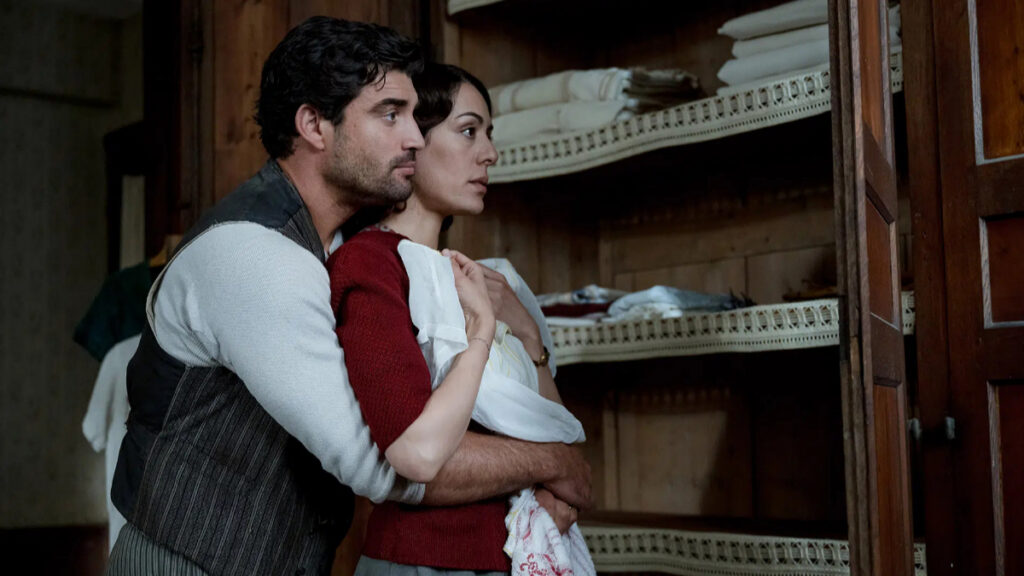
With regard to performance, the ensemble cast proves to be very talented. Julie de Bona portrays the internal struggles of Eugénie very subtly without overdoing it, but on the other hand, Constance Gay shows enough toughness and fragility of her character to make Léonie instantly likeable. The change of Blanche’s character is performed by Nolwenn Leroy very convincingly, while Sofia Essaïdi brings into play both the warmth and desperation of her character, Giulia. All their interplay manages to deliver the overall message of the series, namely that women of very different origins can unite and empower each other.
The visuals in Netflix’s French series Summer ’36 are captivating throughout. The French Riviera appears beautiful, but it is never too glamorous. There is an excellent recreation of 1936’s France through the hotels, beaches, and costumes, but all the while, there is a reminder of the widening gap between the rich and the poor.

Netflix Summer ’36 Review: Summing Up
Overall, it should be admitted that the 2026 series Summer of ’36 is quite an interesting series that fails to reach the level of greatness despite having a lot of promising moments. The most appealing moments in this series include those in which the characters that have been created in an excellent way become the key figures in the narrative, not due to the crime aspect, but due to the excellent character development that helps to be more involved in character development than in the resolution of the crime.
Also Read: Worst Neighbor Ever Review: Disturbing True Crimes That Shock, but Rarely Go Beyond the Headlines
