

Made in Korea Ending Explained: The political thriller 드라마 메이드 인 코리아, directed by Woo Min-ho, was a Disney+ production, and it ended its six-episode series on January 14, 2026. Ambition, betrayal and the unsettling power of victory were among the main issues tackled in the last episode. The 1970s political situation was the background of the series, which revealed that fear and calculated sacrifices rather than ideals were the means for building authority.
Starring Hyun Bin in a stunning makeover as Baek Ki-tae, the series also features Jung Woo-sung as the idealistic prosecutor Jang Gun-yeong, Seo Eun-soo as the clever and persistent Oh Ye-jin, and Won Ji-an as the doubting Ikeda Yu-ji. They are joined by Kang Gil-woo, Jung Sung-il, Roh Jae-won, and Woo Do-hwan in a narrative that treats crime, politics, and human cost as inseparable, thus portraying a man who thinks that power is the only lasting form of protection.
Made in Korea Recap
Korean drama Made in Korea initially presents Ki-tae as a character moulded with violence and exclusion. A daring mid-air hijacking plot, and later, his position in the KCIA’s Busan intelligence division, are ways he is depicted as a person flourishing in turmoil. Ideology never fuels his actions; it is always calculation since he uses geopolitical strife to his advantage. The premier episodes leave no doubts about his crossing of moral lines and depict him as one very much attuned to the ways power works behind the scenes.
At the same time that Ki-tae rises, Prosecutor Jang Gun-yeong is fighting a solitary battle against the corruption in the State. Jang’s inquiry into meth trafficking starts to unravel the unholy alliance of criminal organisations, security services and politicians. Ki-tae is the opposite of Jang in that the latter relies mainly on process and justice, yet he is driven by this very trait that isolates him in a system where to obey is rewarded and to be upright is not. His collaboration with Oh Ye-jin brings some fun into the plot, but this bond is still overshadowed by the imposing presence of the KCIA.

The narrative gradually treats drug trafficking as an illegal trade that is no longer just a business—it becomes the measure of one’s influence. Ki-tae’s act of making the meth trade with Japan is dubbed “patriotic,” thus showing how nationalism is used as an excuse for exploitation. Characters like Dae-il and Yu-ji get closer to Ki-tae, and each one is moved by the motives of either desperation, love, or survival, while the likes of Cheon Seok-jung represent the higher authorities that stand silently in the background, controlling the outcomes without ever getting their hands dirty.
Made in Korea Ending Explained
How Did Ki-tae Try to Back Off Gun-yeong, and Was He Successful?
In Made in Korea episode 6, we see Ki-tae’s efforts to eliminate Prosecutor Jang Gun-yeong are a direct reflection of his dark philosophy. Ki-tae chooses to apply psychological pressure rather than Jang’s political manoeuvring, and he does it by creating evidence that ties Jang’s sister to the communist money, knowing full well that in 1970s South Korea, such a charge would mean social death for the accused. By tying Jang’s sister to a chair and making him listen to the edited tapes, Ki-tae is telling Jang straight that he is prepared to kill the innocent in order to save himself.
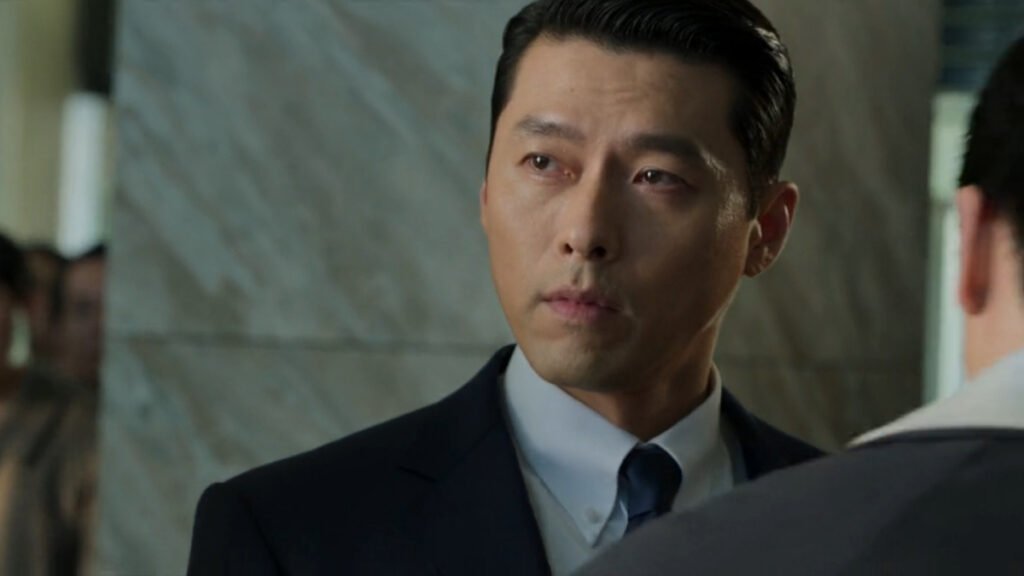
What adds to the discomfort of this showdown is the unyieldingness of Jang. On the contrary, he is even more oppositional, thus deepening the ideological divide between the two. For Jang, justice comes at the cost of personal suffering; for Ki-tae, the ends of survival and domination can justify any harshness. Even though Ki-tae takes Jang off the hook for a while on Pyeong-hak-su’s advice, the hurt is immense—the word has gone forth.
What Happened to Ki-hyun?
Ki-hyun is everything that Ki-tae does not represent. The military officer of integrity, Ki-hyun, is of the opinion that authority should be earned and not taken. His narrative depicts the price of morality in the midst of corrupt organisations where he is subjected to harassment, scapegoating, and professional throttling. In spite of the fact that Ki-tae steps in to shield him, Ki-hyun turns down his brother’s assistance because he thinks that it is just another form of corruption.
The sequence in Vietnam is of great importance. Ki-hyun does not know that he is being placed in the same place as Ki-tae during a drug deal, equipped with recording devices that are meant to bring his brother’s wrongdoings to light. When a bomb goes off, Ki-tae acts on instinct and saves Yu-ji, thereby revealing himself to Ki-hyun. The scene is quiet but heart-wrenching—Ki-hyun gets irrefutable evidence of what Ki-tae has turned into.

After this meeting, Ki-hyun is no longer a character in the story. The narrator’s absence is deliberate and symbolic. It suggests a complete rupture of relationships, not by fighting but by being disillusioned with the morals. Ki-hyun leaves, taking a stand against corruption and showing how far the emotional cost is that Ki-tae never really recognises.
How Did Dae-il Die?
One of the most sorrowful instances in the series Made in Korea is Dae-il’s death, since it is influenced by love rather than power. Dae-il, who used to be a scheming criminal bent on ascending to the top, gets slowly transformed into a normal person through his bond with So-yeong. By the end of the series, his values have completely changed—her safety is more important than his life.
When Dae-il is taken by Gun-yeong, he comes to the conclusion that the law is not going to be merciful to him ever again. So-yeong will not be implicated or be used as a bargaining chip; he takes over the story in the only way that is left to him. Dae-il, by shooting himself with unadulterated heroin and creating a false confession that points to Gun-yeong, martyrs himself to protect her.

His death is a clear manifestation of the cruel contradiction of the universe that has been created by Ki-tae. Being loyal and loving just means being weak and not having the power. Dae-il is killed not as a drug lord, but as a victim of war between men who are never held accountable for their actions and who never face the consequences of their actions.
How Did Gun-yeong Get Arrested and What Happened to Him in the End of Made in Korea?
Gun-yeong’s breakdown is not a result of his lack of trying or insight, but the flawed system he relies on. Ki-tae’s approach to intimidating him by using his sister results in Gun-yeong being even more dedicated to the job of exposing Ki-tae’s misbehaviour. He collaborates with Chief Na and is even prepared to demean himself, in fact, drinking from Na’s shoe, to show loyalty and desperation. This scene is crucial because it signifies how low Gun-yeong has fallen in the power spectrum; even the honest prosecutor must belittle himself to be heard.
The clincher comes when Ki-tae uses Gun-yeong’s past against him rather than something he invents. During the interrogation, Ki-tae mentions to him how his father is a meth addict who killed his wife. This unmasking is not only personal cruelty, but it recasts Gun-yeong’s state image. In a government obsessed with appearances and ideological purity, Gun-yeong’s family background becomes a political liability. The hidden message was loud and clear: an individual moulded by such a background can’t be trusted.
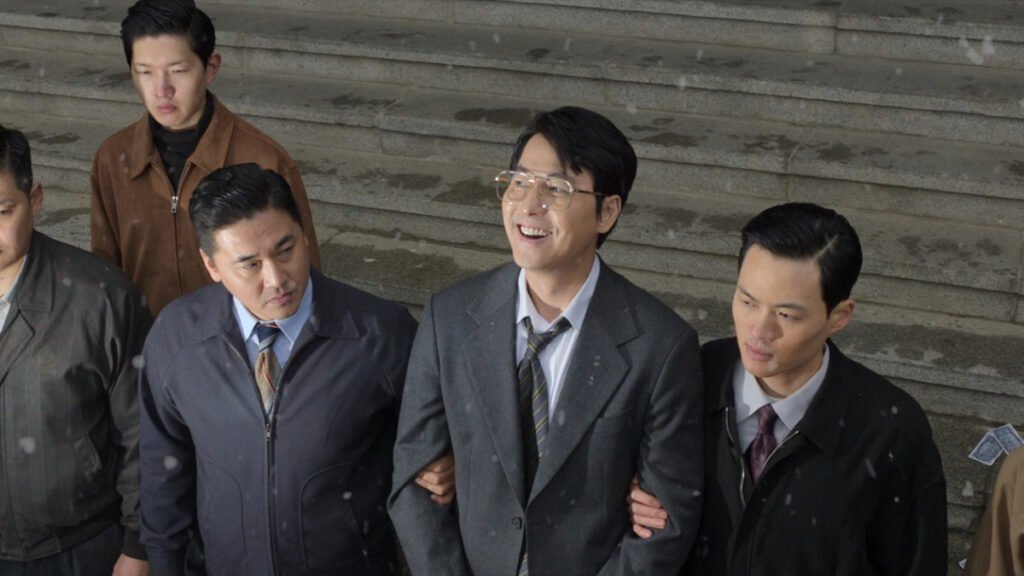
In the Made in Korea end, Gun-yeong gets arrested, but not as a result of Ki-tae proving him wrong, rather Ki-tae proving he is not needed. Cheon Seok-jung’s shield ensures Ki-tae is free while Gun-yeong is pushed away and thrown out. His fate is left to be intentionally dark—no majestic last battle, no vindication. Gun-yeong becomes another victim of a system where, unless it supports the power, the truth is of no value. His arrest is the last victory of Ki-tae’s philosophical worldview and is, therefore, the core message of the series: in Made in Korea, justice does not get lost because of weakness but because it is unwanted.
Does Ki-tae Succeed in Taking the Director General Position?
Indeed, Ki-tae at the end achieves his lifelong ambition. He secures himself a place in the eyes of the most influential people by giving Cheon Seok-jung, who is the ruler in Korea, the largest amount of money that he could possibly deliver for the sake of political stability. Meanwhile, Ki-tae manages to keep his drug business going and to be completely hidden from the local market, so he could picture himself as a businessman who is not only giving but also loyal to the country.

The arrest of Gun-yeong gets rid of the last major barrier, and Cheon’s constant support guarantees Ki-tae’s elevation. By the end of the season, Ki-tae has risen to the position of the Director General of the KCIA, which is the final step in his evolution from being a disfavour able Zainichi outsider to being one of the most powerful men in South Korea. The series wraps up with a grim warning: the power that is acquired never brings satisfaction; it, instead, requires more.
Will There Be Made in Korea Season 2?
With Disney+ officially stating that Made in Korea Season 2 is going to be released in late 2026, the fans are very much eager to know the next part of the story- and what the unresolved issues are, if any, after the Season 1 dramatic end. Although the finale closes some narrative arcs, it opens several questions regarding the character’s loyalty, political stability, and the actual impact of Ki-tae’s rise to power.
To begin with, the ending per se gives the future conflict a strong background. Ki-tae finally realizes his dream of becoming Director General of the KCIA police, but at a massive personal cost- he has totally distanced himself from his brother Ki-hyun, no longer has any moral values, and is deeply involved in bribery. The main question for Season 2 of Made in Korea is raised: What if the political scenario changes? Historically, Cheon Seok-jung and Na are among many who have shown that in this world alliances are constantly shifting and Ki-tae’s rapid climb has given rise to a new set of enemies as well as allies.
To add to this, the fates of some characters are tangled in a way that is open to be explored more in the next season. The arrest of Prosecutor Jang Gun-yeong does not necessarily lead to loss of his power; the prison might turn out to be a different place for resistance. Yu-ji’s plans for the Japanese meth market, So-yeong’s pregnancy with Dae-il’s child, and the still not clear picture of how Ki-tae’s activity has affected South Korea’s position in the world, all these present the perfect backdrop for the story to continue- especially in the political thriller genre which thrives on moral issues and tension within the institutions.
Also Read: The Boyfriend Season 2 Review: Love, Baggage, and a Very Different Vibe
