

The Great Flood Ending Explained: Directed and written by Kim Byung-woo, Netflix’s Korean film 대홍수 is fronted by Kim Da-mi as An-na and Park Hae-soo as Son Hee-jo, with a striking performance from young actor Kwon Eun-seong as Ja-in. This 106-minute film, at first presented as a survival story in the midst of a looming disaster, turns out to be not just about the battle for survival amidst rising waters but a meditation upon memory, motherhood, and what the future of humanity might look like, thus being far more layered than initially meets the eye.
Korean Movie The Great Flood Recap
The narrative starts with An-na and her son Ja-in experiencing what seems to be an ordinary day when, suddenly, the incessant rain becomes a global disaster. With the collapse of the infrastructure and the fear spreading around, Seoul is flooded with water. An-na, who is trapped with her son inside a high-rise building, turns her focus on keeping Ja-in alive as the flood rises one floor at a time.
Their already difficult situation gets complicated when Son Hee-jo shows up claiming that he was sent to lead them to the place of safety. He boldly asserts that An-na is the key to the survival of humankind, but at the same time, he does not reveal the important information. While they are wading through flooded hallways, using broken lifts, and navigating dangerous creeks, the film continues to put An-na into tough moral dilemmas where she has to decide between the two opposite extremes of survival and mercy.
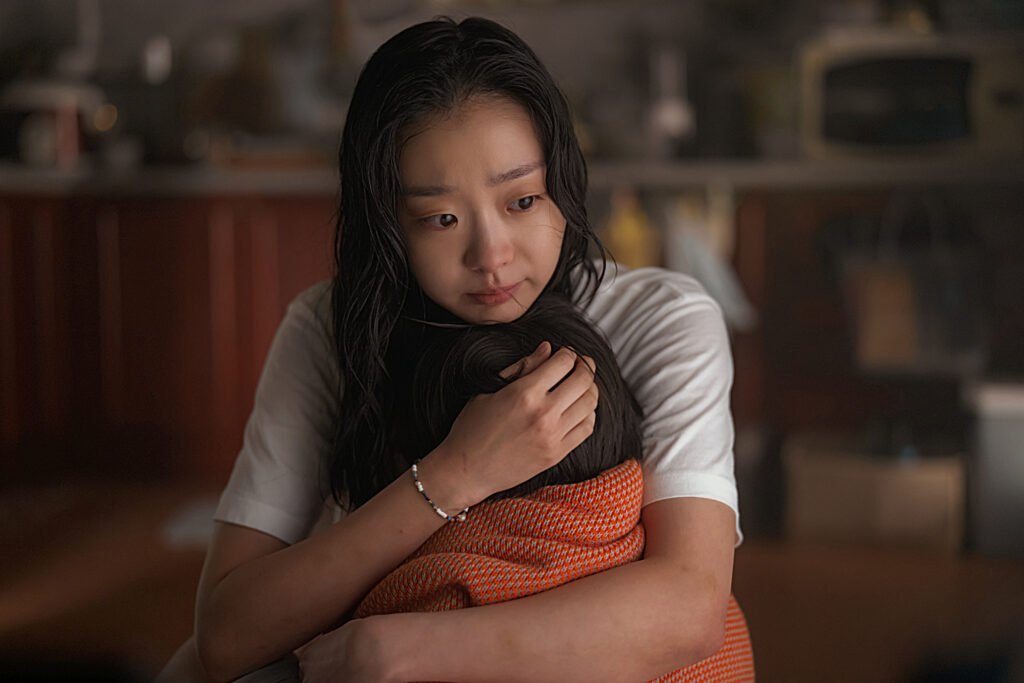
As the plot of the Korean movie The Great Flood goes on, the seemingly simple disaster narrative starts to unravel. Some incidents are repeated, Ja-in exhibits his behaviour uninterruptedly, and An-na goes through unexplainable déjà vu moments. The bizarre occurrences raise the possibility that the flood is not entirely a natural disaster — or even real.
When the film crosses its two-hour mark, it has become apparent that the calamity is linked to An-na’s role in a cutting-edge research project dubbed the Emotion Engine. From here on, The Great Flood changes its tempo and gradually leads us to its emotionally charged and philosophically elaborate conclusion.
The Great Flood Ending Explained
What Was the Real Reason Behind the Flood?
The flood in The Great Flood is not just a natural disaster but a planetary extinction event. In the larger context of the film, an asteroid hitting Antarctica results in quick ice melting and disastrous sea-level rise. After that, a second meteor fallout occurs, making Earth mostly uninhabitable and killing off the majority of humans.

Nevertheless, the flood that An-na goes through repeatedly in the film is not a real-time event. On the contrary, it is part of a controlled simulation meant to replicate the last day of her life. The simulation constantly replays the disaster scenario, and An-na’s consciousness is able to live it over and over again as part of a bigger experiment.
The selection of this particular event is very intimate. The flood signifies the instant when An-na not only did not save her child but also lost the world at the same time. By putting her through this trauma over and over again, the simulation is checking if any emotional maturation, moral instinct, or even unconditional love can arise in such unbearable circumstances. In other words, the flood is not merely destruction — it is a trial.
Who Was Ja-in and How Was He an Experiment?
Ja-in is not a human child of the same kind as a biological human child. He is an artificial person created by advanced bioengineering as a part of the project called Emotion Engine. Although the scientists had already got the physical aspect of the human body down, they had not yet been able to duplicate the emotions, which are the crucial part of re-creating humanity.

An-na came up with a solution that went against all the conventions: emotions could be developed only through experience. Ja-in was created as a baby, and he was taken care of by An-na, and in the actual world, he was going through all the big and small emotions like love, fear, joy, and even loss. Eventually, these emotional reactions were to be accumulated and stored inside him.
The very fact that he was Ja-in is that he remembers some of the experiences from the previous cycles of the simulation. While An-na is forgetting and slowly discovering the truth again, Ja-in is in his subconscious, recalling the moments when he was waiting for her, hiding and trusting that she would come back. The continuity of this emotion is the proof that the experiment was successful – he has acquired true emotional intelligence, not merely programmed behaviours.

Also Read: 2025 Melon Music Awards Lineup, Where to Watch, Nominations and All We Know So Far
What happened to Son Hee-jo at the End of The Great Flood?
Son Hee-jo’s fate is one of the film’s quiet tragedies. In reality, he is just a facilitator-a disposable asset whose task it is to usher An-na along to the evacuation point. Convinced that he will be saved, he is ultimately executed once his function is complete, showing how little value the system places on human life outside its grand design.
In the simulacrum, Hee-jo becomes a recurrent figure that takes form through An-na’s memories. At first, he beseeches her to leave Ja-in and survive, which reflects his own unresolved trauma of having been abandoned as a child. As An-na starts remembering the previous loops, she also remembers what happened to him.

When she finally confronts him with the truth – that he will die regardless – Hee-jo’s role shifts. He chooses to help An-na reunite with Ja-in, becoming an ally rather than an obstacle. However, unlike An-na and Ja-in, Hee-jo’s consciousness is not preserved. When the simulation ends, so does his existence, underlining the film’s bleak view of lives that are indeed expendable.
Did An-na Succeed in Finding Ja-in?
The journey of An-na through the simulation lasts for tens of thousands of loops. Every cycle begins with a flicker of hope, only to end in failure as Ja-in vanishes before she can get to him. With each repetition, memories come back — not in a logical way but through emotions.
The breakthrough is not a result of reasoning but of feeling. An-na stops pursuing the rational escape routes and gives in to her maternal instinct. This takes her to the rooftop closet where Ja-in has been hiding all the time, just as she had told him when they were separated in the real world.

Their meeting is the emotional completion of the Emotion Engine. Ja-in assures that he has never felt left behind because he kept her promise in his memory. At that moment, An-na shows that it is love, not survival, that determines humanity. The loop is broken because the experiment is successful.
Also Read: Winners of Melon Music Awards 2025: G-Dragon Takes Best Male Solo as Hearts2Hearts Win Fan Choice (LIVE)
What Does the Ending of The Great Flood Signify?
The ending of The Great Flood indicates a cycle of nature coming back to life instead of just a few people coming out alive. An-na and Ja-in rise in new and fresh bodies on a spaceship that is returning to Earth. They have shed their digital skin and are now the carriers of emotional memory, which is the very basis for the future of mankind.
The last scenes reveal numerous ships approaching a planet that is healing up, implying that An-na’s victory has made it possible to have many mother-child pairs. The new mankind will not be an offspring of power and cleverness but will emerge through the bond of feelings.
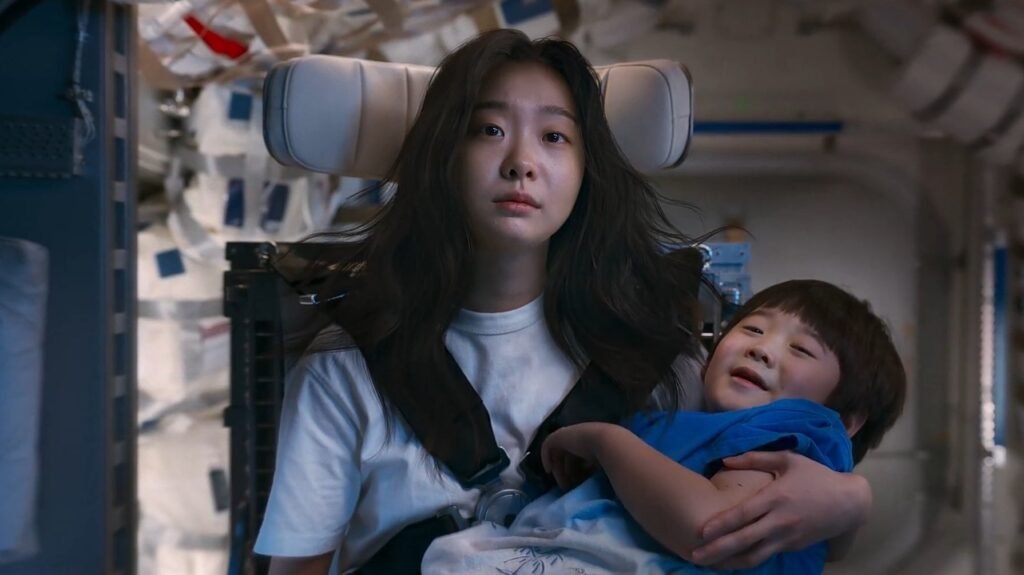
Eventually, the End of The Great Flood maintains that the very traits that make us human are not perfection, logic, or efficiency, but love, sacrifice, and the willingness to choose one another even when the world is about to end.
Also Read: The Great Flood Review: Kim Da-mi Stands Out in an Otherwise Cluttered Survival Drama
