

The Swedish Connection Review

Director: Thérèse Ahlbeck and Marcus Olsson
Date Created: 2026-02-20 02:14
3
The Swedish Connection Review: Directed by Thérèse Ahlbeck and Marcus Olsson, and starring Henrik Dorsin as Gösta Engzell alongside Sissela Benn, Jonas Karlsson, Marianne Mörck, Jonas Malmsjö, and Carl Jacobson. Den svenska länken is a dramatisation of World War II. The movie looks at history from a different perspective through documents, procedures, and the subtle ways people resisted via and through the bureaucracy, but in ways people could not imagine.
The Swedish Connection Review
There are enough World War II movies that follow the action of battles, camps, and secret resistance. Netflix’s The Swedish Connection is not one of them. It replaces the action of explosions with the action of papers, documents and stamps. And it all centres around Gösta Engzell, a Swedish foreign ministry official living in a time when neutrality can be interpreted as silence.

First of all, the film gets you with its quiet heroism. Engzell is no flashy, save-the-day hero, and he doesn’t materialise out of thin air to save the day. He’s a soft-spoken, slightly awkward man, hidden away in a small office with a small staff. Sweden remains neutral in the war, but The Swedish Connection movie quietly wonders what it really means to be neutral when trouble is right outside the door. Persecution tales are dismissed as rumours. Refugee appeals are simply administrative nuisances. The system is not in place to save people; it’s in place to slow things down.
Then something begins to change within the system. The conflict is not ignited by the sound of artillery fire but by a growing sense of conscience. As the true extent of Nazi terror becomes increasingly difficult to ignore, Engzell is forced to carry the weight of inaction. This is no sudden, thunderous cry but a gradual, almost reluctant shift. I liked this aspect of the movie, not shouted from the rooftops in grand speeches but in small actions, in the quiet recognition that sometimes following orders is the same thing as following one’s conscience.
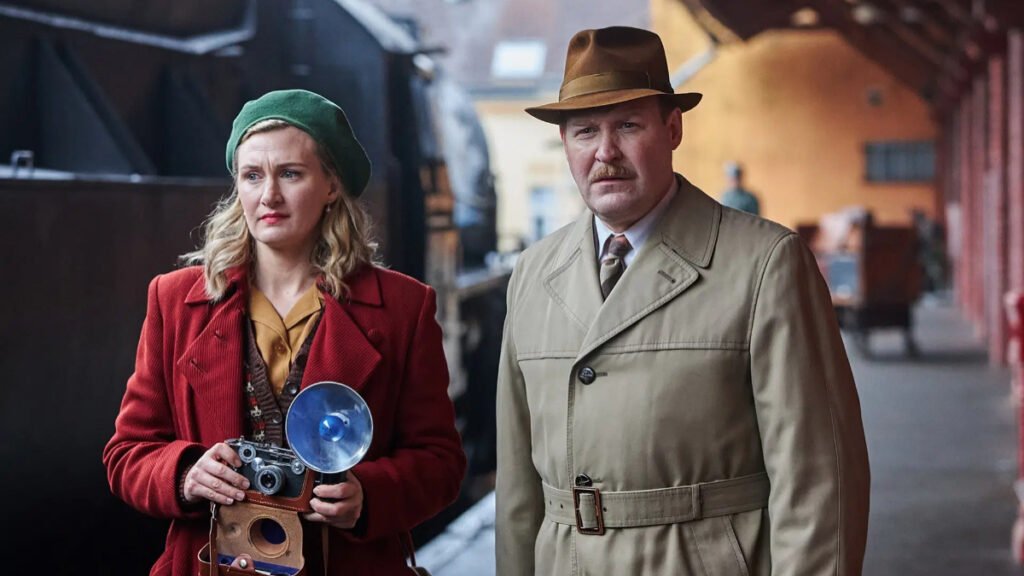
The movie begins with a definite tone: lightly comedic, almost whimsical. Bureaucrats rush down corridors, dialogue laced with satire, and Engzell’s awkward charm brings a warm, gentle touch. It works for a while, making the movie accessible and, more importantly, different from the many other dark WWII movies we’ve all seen.
As for the acting, the cast is where the real meat of the story is. Henrik Dorsin brings a sense of understated presence to Engzell, who is no loud-mouthed rebel but a man struggling with fear. There is a sense of tension in his performance, the underlying fear hidden beneath the politeness. It’s not a role that calls for pyrotechnics, but Dorsin ensures that Engzell’s inner turmoil is always apparent.
For an unorthodox approach towards expressing the urgency and the moral obligation to act, Sissela Benn’s character has a pivotal role in initiating change without rendering her role as some sort of parody of righteousness or heroic stature. Jonas Karlsson and the rest of the supporting cast successfully portray an obstructive, bureaucratic resistance, or ones that follow protocols and procedures rather than horrific acts of cruelty. No single portrayal is overly theatrical or portrays the actor as being larger than life; rather, the portrayals are relatable and based on reality, therefore, they help enhance the film.

The greatest success of the Netflix movie The Swedish Connection is that it successfully embodies the premise that resistance is not always evident in a dramatic way, such as processing paperwork that should not have been processed, exploiting legal loopholes, or choosing not to ignore a file that others wish to archive or forget about. The film reminds the viewer that people are the ones who operate systems, and that those individuals have the ability to shape the systems in a more humane manner.
While the movie doesn’t go fully beyond the usual multi-spot cycles of historical dramas, after the novelty of the “bureaucracy as rebellion” wears off, it has a pretty predictable way of unfolding after that. You can see the stakes; the moral of the story is very clear, and none of the emotional arcs will surprise you at all. I kept waiting for a fuller representation of the consequences for the individual, or a deeper representation of the tension between the political leaders of Sweden and Engzell’s office.

Despite the pacing and the tonal variation, I don’t want to dismiss what the film has been able to accomplish. It causes people to examine the comfort of neutrality; it challenges the notion that going to work every single day means you’re not personally responsible; and even though it does not do anything to reinvent this genre within World War II, it does give us another perspective that seems to be quietly relevant today.
Netflix The Swedish Connection Review: Summing Up
To sum up, The Swedish Connection is a strong historical drama that is skillfully produced and performed, though the film never really connects emotionally to its audience. The movie is well-made, informative, and meaningful, but it has some predictable elements to it that detracted somewhat from my overall enjoyment. For me, the movie is exactly in the middle, worth seeing but not good enough to really stick with you after you leave the theatre.
Also Read: 56 Days Review: Dove Cameron and Avan Jogia’s Erotic Thriller Is Moody, Messy, and Overlong
